
SEO in 2026 and beyond is defined by AI-powered results, local intent, and entity-based ranking. If your strategy relies solely on branded searches (people already looking for you) or only on non-branded keywords (generic terms), growth will eventually stall.
The most stable path forward is a balanced approach: Non-branded search helps people find you, while branded search helps them choose you.
Contents
- 1 How Branded and Non-Branded Traffic Work Together
- 2 Find and Categorize Your Organic Keywords
- 3 How to Grow Your Non-Branded Traffic Share
- 4 How to Strengthen Branded Traffic Share (Ethically & Scalable)
- 5 Reality Check: Ideal Branded vs Non-Branded Ratios
- 6 How Technical & Entity SEO Support Branded and Non-Branded Growth
- 7 A Practical Framework for Growth
- 8 1. Strengthen Your Brand Entity
- 9 Common Pitfalls to Avoid
- 10 Final Thought
How Branded and Non-Branded Traffic Work Together
Instead of viewing these as separate channels, treat them as interconnected stages of a single customer journey.
Phase 1: Non-Branded Search Creates Discoverability
Non-branded searches come from users who know their problem but don’t yet know who to trust for the solution.
- Generic Examples:
- “Best skin clinic near me”
- “Affordable digital marketing agency”
- “Project management software for small teams”
At this stage, the user is comparing options. To win here, your business must rank for relevant queries by publishing helpful, high-quality content that establishes you as a credible option.
Phase 2: Branded Search Signals Trust and Intent
Once a user interacts with your helpful content, they often return via a branded search. This shift suggests growing trust and indicates the user is moving closer to a decision.
- The Shift:
- Initial search: “How to improve SEO”
- Follow-up search: “[ Brand Name] Bike services reviews” eg: (Ather bike services reviews)
- Decision search: “[ Brand Name] pricing” eg: (Nike shoes price)
Phase 3: Simplified Conversion
Branded traffic typically converts at a much higher rate because the user has already vetted you. They may have seen your social media, consumed your blogs, or heard about you through word-of-mouth. At this point, SEO’s role shifts from acquisition to reinforcement.
Find and Categorize Your Organic Keywords
1. Using Google Search Console (GSC)
The most accurate data comes from the Google Search Console (GSC). You can find the queries that users used to land on the website. In order to segment the queries into branded and non branded follow these steps.
To find branded traffic performance:
Step 1: Go to the “Performance tab” in GSC.
Step 2: Click +Add Filter > Query
Step 3: Select Custom (regex) from the dropdown.
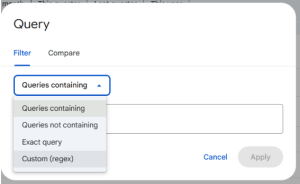
Step 4: Select Matches regex. and enter your brand name and variations separated by a pipe( |) symbol.
eg :- .*(netstager|net stager|netstager technologies).*
(Replace netstager with your own brand name.)
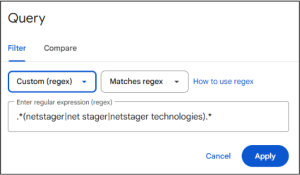
So what does this regex formula mean? *().*
- . → matches any single character (letter, number, symbol, space, etc.)
- * → means zero or more times
So: - .* → means match anything (any number of any characters)
- netstager|net stager|netstager technologies → Your brand name variation
So together – .*(netstager|net stager).*
Means:
Any search query that includes the word “netstager or net stager” anywhere (beginning, middle, or end).
Examples of Branded Searches (Included)
- netstager
- netstager seo
- contact netstager calicut
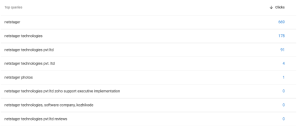
All of these contain the brand name netstager, so they are counted as branded traffic.
To find non-branded traffic performance:
Step 1: Go to the “Performance tab” in GSC.
Step 2: Click +Add Filter > Query
Step 3: Select Custom (regex) from the dropdown.
Step 4: Select Doesn’t Match regex. and enter your brand name and variations separated by a pipe symbol( | ).
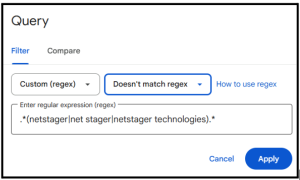
Examples of Non-Branded Searches (Excluded)
- best seo company in kerala
- seo services calicut
- digital marketing agency india
These do not include the brand name and are classified as non-branded keywords.
2. Make Use of Third-Party Tools (Ahrefs/SEMrush)
Use these to find gaps in your strategy. Run an Organic Keywords report for your domain and apply an Exclude filter for your brand. This isolates the “Non-Branded” space where you are competing with others.
Non-branded traffic fuels the discovery of your website, but not all non-branded keywords is equally valuable. Here’s how to grow it strategically:
1. Build Topic Clusters (Not Random Blogs)
A strong topical cluster helps search engines connect your content across intents and improves authority for larger keyword sets:
- Core service or solution page
- Supporting content: how-to’s, comparisons, use cases, FAQs
Example:
Core: SEO services
Clusters: Local SEO services, SaaS SEO services, e-commerce SEO services
This structure helps you rank for many related searches, capturing both early research and mid-funnel queries.
2. Map Content to Search Intent
Non-branded traffic spans multiple intent types:
- Informational: Answer questions people are asking broadly
- Commercial: Position your solution among options
- Transactional: Capture users ready to convert
Too many brands overproduce generic content. Focus instead on intent-mapped content that matches what people are actually trying to accomplish in search.
3. Use SERP-Driven Keyword Selection
Look at the SERP features showing up for your target keywords:
- Are there reviews, comparisons, or commercial pages?
- Do people type in product queries expecting to buy?
If Google shows buyer-oriented results, ranking for those keywords will likely bring higher-quality traffic that searches without your brand name but with real purchase intent.
Non-branded traffic introduces your brand. To turn those visitors into brand searchers, you need to reinforce your brand across the user journey:
1. Turn Non-Branded Visitors Into Brand Searchers
- Strong internal linking to brand assets
- Memorable positioning and value messaging
- Consistent mention of your brand name in content
People should remember who helped them, not just the article they read.
2. Own Your Brand SERP
Your branded presence in search should be fully optimized:
- Homepage
- About page
- Case studies
- Reviews
- FAQs
- Knowledge panels (if applicable)
A complete brand SERP ensures that when someone searches your name, they find you and trust you instantly.
3. Publish Content That Reinforces Brand Authority
Produce content where your brand adds unique value:
- Case studies with real data
- Original frameworks and research
- Founder or leader POV pieces
- Expert insights and opinion pieces
This boosts repeat brand searches because you become a go-to source in your niche.
Reality Check: Ideal Branded vs Non-Branded Ratios
There’s no universal rule, but here’s a practical guideline based on average patterns:
- Early-stage / growing brands:
80–90% non-branded / 10–20% branded (focus on awareness + SEO reach) - Established brands:
60–70% non-branded / 30–40% branded (balance growth + conversions) - Authority brands:
50–60% non-branded / 40–50% branded (strong brand search complements discovery)
If branded traffic exceeds 60%, growth often plateaus because you’re relying mostly on people who already know you. Brands that dominate non-branded search expand their market share faster.
How Technical & Entity SEO Support Branded and Non-Branded Growth
Technical SEO ensures your website is easy for search engines to crawl, index, and rank.
Key actions include:
- Fast page speed for better user experience
- Mobile-friendly and responsive design
- Clean URL structure and proper indexing
- Secure HTTPS and fix broken links
These improvements help non-branded keywords, such as service- or problem-based searches, reach new audiences effectively.
Entity SEO: Strengthening Brand Recognition
Entity SEO focuses on making search engines understand your business as a real, trustworthy brand.
Key actions include:
- Using structured data and schema markup
- Maintaining consistent business information (name, address, phone)
- Collecting and displaying reviews
- Linking website with social profiles and directories
Combined Impact
- Attracts new users through non-branded searches
- Builds brand recognition for branded searches
- Converts discovery traffic into loyal, brand-aware users
- Supports long-term, sustainable SEO growth
A Practical Framework for Growth
To achieve a sustainable balance, follow these four steps:
1. Strengthen Your Brand Entity
Before scaling, ensure your brand is clearly defined.
- Optimize “About” and “Team” pages: Use real names, credentials, and clear missions.
- Technical Schema: Use suitable schema markup to help search engines understand who you are and what you do.
2. Target Non-Branded Topics with Intent
Avoid “empty” traffic. Focus on keywords that your actual customers use.
- High-Intent: “Best [Service] for [Target Audience]”
- Educational: “How to solve [Problem]”
- Comparison: “[Product A] vs [Product B]”
3. Create Bridges to Branded Pages
Never let a non-branded blog post be a dead end. Use internal links and clear Calls to Action (CTAs) to move users toward your service pages or brand-specific content.
4. Measure the Connection
Don’t just look at total clicks. Use tools like Looker Studio to visualize the relationship between the two traffic types:
- Do branded searches increase after a non-branded content campaign?
- Which non-branded pages lead to the most “Assisted Conversions”?
- Is your brand’s “share of search” growing in your specific industry?
Common Pitfalls to Avoid
- The “Brand-Only” Trap: Relying only on your reputation limits you to people who already know you, making it impossible to scale.
- The “Traffic-Only” Trap: Chasing high-volume non-branded keywords that have nothing to do with your service leads to high bounce rates and zero conversions.
- Ignoring the Journey: Treating every visit as a one-time event rather than a step toward building long-term trust.
Final Thought
The future of SEO isn’t about choosing between branded and non-branded keywords; it’s about designing a system where they feed each other. Non-branded content brings the world to your door; branded content invites them inside.